Upgrading Old Plug-in to the New LitHub Connect

DeepDyve's latest browser plug-in is now called LitHub Connect, and it works with Chrome, Firefox, and Edge  LitHub Connect helps you see what articles are available for reading in DeepDyve while you're looking at other sites. Older versions of this plug-in worked only with PubMed, Google Scholar, and a few other sites. LitHub Connect works with any site you are browsing, plus with AI tools including ChatGPT, Claude, Gemini and Perplexity - but you need to take steps to activate it.


The old version of the Plug-in will no longer work until you take these steps to upgrade.

Sections in this article:

  1. Upgrading on Chrome
  2. Upgrading on Firefox
  3. Upgrading on Edge

Upgrading on Chrome

Go to where you manage extensions

To upgrade on Chrome, go to where you manage your extensions. You can do this three ways:

  1. Click the extension icon in the upper right corner, then go to "Manage Extensions" at the bottom of the list that comes up:

Screenshot of Chrome's extensions popup, opened from the puzzle-piece extension icon in the toolbar (an orange arrow points to it). The popup is titled 'Extensions' with a 'Full access' section, and a yellow highlight box marks the 'Manage Extensions' item with a gear icon at the bottom of the popup.

  1. Go to "Window" in the browser menu and click "Extensions":

Screenshot of the Chrome 'Window' browser menu on a Mac, with the 'Extensions' menu item highlighted in green, between Downloads and Task Manager.

  1. Click the three dots in the upper right of the menu bar and go to "Extensions" and "Visit Chrome Store":
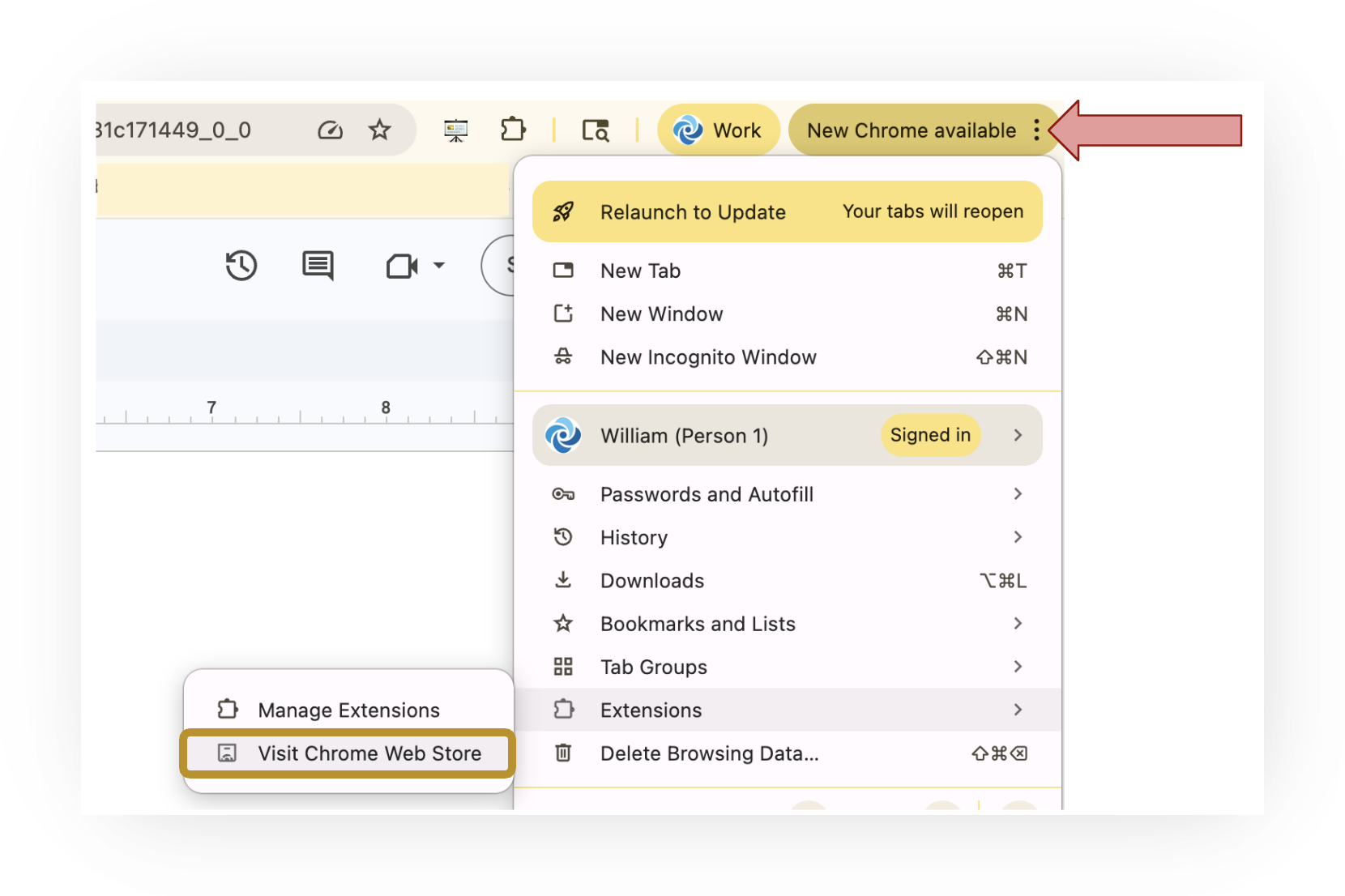
    Screenshot of Chrome's three-dot menu (a red arrow points to the three dots in the upper right of the toolbar, next to a 'New Chrome available' notice). In the menu, hovering 'Extensions' opens a submenu where a highlight box marks 'Visit Chrome Web Store' beneath 'Manage Extensions'.


Give the LitHub Connect permission to work with all sites

Check that extension has permission to work with all sites. You're all set! To see how the new LitHub Connect works with all sites, see our article here.


Upgrading on Firefox

Go to where you manage extensions

To upgrade on Firefox, go to where you manage your extensions. You can do this three ways:

  1. Click the extension icon in the upper right corner, then select "Extensions" in the tab that comes up:

Screenshot of Firefox's extensions popup, opened from the puzzle-piece extension icon (an orange arrow points to it). In the tab that opens, 'Extensions' is highlighted in blue among Recommendations, Themes, and Plugins.

  1. Go to "Tools" in the browser menu and click "Add-ons and Themes":

Screenshot of the Firefox 'Tools' browser menu on a Mac with 'Add-ons and Themes' (shortcut Shift-Cmd-A) highlighted in green, between Downloads and Sign In.

  1. Click the three lines in the far right corner of the browser toolbar, then select "Add-ons and Themes":

Screenshot of Firefox's hamburger menu, opened from the three-line icon at the far right of the toolbar (an orange arrow points to it). The 'Add-ons and themes' item (shortcut Shift-Cmd-A) is highlighted in the menu, below Bookmarks, History, Downloads, and Passwords.

Find and toggle on LitHub Connect

Find LitHub Connect. With the release of the new version the old Plug-In extension was automatically disabled. Click the toggle to turn LitHub Connect on:

Screenshot of Firefox's 'Manage Your Extensions' page. Under 'Enabled', DeepDyve LitHub Connect has its toggle switched on (blue). Under 'Disabled', the old 'DeepDyve Plugin (disabled)' has its toggle off — with the new release the old Plug-In is automatically disabled, and the toggle next to LitHub Connect is the one to turn on.

Start using it

You're all set! To see how the new LitHub Connect works with all sites, see our article here.


Upgrading on Edge

Go to where you manage extensions

To upgrade on Edge, go to where you manage your extensions. You can do this two ways:

  1. Click the extension icon in the upper right corner, then select "Extensions" in the tab that comes up:

Screenshot of Edge's extensions popup, opened from the extension icon in the toolbar (an orange arrow points to the three-dot area). A yellow highlight box marks 'Extensions' in the menu and 'Manage Extensions' / 'Visit Chrome Web Store' in the submenu that opens to the left.

  1. Click the three dots in the far right corner of the browser toolbar, then select "Extensions":

Screenshot of Edge's three-dot 'Settings and more' menu, opened from the far right of the toolbar (an orange arrow points to it). The 'Extensions' item is highlighted in a yellow box, below New Tab, New Window, Zoom, Favorites, History, Downloads, and Apps.

Remove the current Plug-in & install LitHub Connect

The latest Plug-in hasn't yet been submitted to the Edge store. To get the latest version, you'll first have to remove the Edge Plug-in if you have it:

Screenshot of Edge's 'Installed extensions' page. Under 'From Microsoft Edge Add-ons Store', the old 'DeepDyve Plugin' (DeepDyve Plugin for Edge) is listed with its toggle on, and a yellow highlight marks the 'Remove' link next to 'Details' — the link to click to remove the old Edge Plug-in.

Next, go to the Chrome Web Store to search for the new DeepDyve LitHub Connect:

Screenshot of Edge's 'Find new extensions' page with a 'Get extensions for Microsoft Edge' button and the sentence "Can't find what you're looking for? You can also get extensions from the Chrome Web Store" — the 'Chrome Web Store' link is highlighted, since the new LitHub Connect is installed from the Chrome Web Store.

Click "Get" to install LitHub Connect.


Start using it

You're all set! To see how the new LitHub Connect works with all sites, see our article here.

Still need help? Contact Us Contact Us